How Flock cameras are changing ELD and HOS compliance
ALPR sightings can expose gaps between a truck's actual movement and a driver's log. Here is how fleets can use that signal responsibly.

Sasho Najdov
Founder & Solution Architect, IT Engineering

A new source of objective movement evidence
Flock Safety cameras are automated license plate recognition (ALPR) cameras. When a vehicle passes a camera, the system can capture the plate and vehicle characteristics and associate the sighting with a place and time. A single sighting does not explain who was driving, why the vehicle moved, or what duty status applied. It does, however, create an independent data point about vehicle movement.
That matters for ELD and hours-of-service compliance. An ELD log tells a recorded story through driving events, duty statuses, locations, edits, and annotations. An authorized ALPR sighting can provide a second timeline. When the two timelines conflict, the carrier may have a log error, an assignment problem, improper personal conveyance, unidentified driving, or potentially a falsified record of duty status that needs prompt investigation.
How falsified logs can be exposed
Imagine that a driver's record shows the vehicle in sleeper berth or off duty at 2:10 a.m., while a reliable plate sighting places the assigned truck moving through another location at that time. The mismatch is not automatic proof that the driver falsified a log. Plates can be misread, equipment can be reassigned, team drivers can switch, and timestamps or vehicle mappings can be wrong.
It is still a serious exception. FMCSA investigators use time, date, and location evidence—including GPS records—to check records of duty status for falsification. A sound internal review applies the same investigative discipline: validate the sighting, identify the vehicle and assigned driver, compare the complete ELD event history, and review dispatch, fuel, toll, bill-of-lading, and communication records before reaching a conclusion.
- Confirm the plate read, timestamp, location, time zone, and direction of travel.
- Verify which tractor, driver, co-driver, and ELD account were assigned.
- Compare the sighting with driving, off-duty, sleeper-berth, personal-conveyance, yard-move, and unidentified-driver events.
- Check whether another reliable operating record supports or contradicts the sighting.
- Document the review, preserve relevant records, and coach or escalate based on verified facts.
The gray zone between privacy and compliance
Flock sits in a genuine gray zone between privacy and compliance. A plate is visible on a public road, and objective movement records can help detect unsafe or falsified logs. At the same time, a searchable network of time-stamped vehicle sightings can reveal patterns of movement. That creates legitimate questions about access, purpose, retention, sharing, accuracy, and driver notice.
Carriers should not treat broad surveillance as a shortcut to safety. Access to ALPR information varies by camera owner, contract, jurisdiction, and applicable law; it should never be assumed. Any compliance use should have a defined business purpose, authorized access, narrow queries, role-based permissions, audit logs, retention limits, and a process for correcting false matches. Drivers should know what fleet data is reviewed and why. Consult qualified counsel before adopting ALPR data in an employment, disciplinary, or regulatory process.
Our one-of-a-kind ALPR Inspector
ELD Engine has built a one-of-a-kind ALPR Inspector that helps our compliance team correlate authorized ALPR movement evidence with ELD log duty-status events. Instead of manually comparing isolated screens, the tool brings the vehicle sighting and the relevant log timeline together so an analyst can identify mismatches that deserve review.
The value is not simply finding a truck on a map. It is converting a movement signal into a controlled compliance workflow. Our team can validate the underlying records, review surrounding context, flag possible falsified logs, and document the resolution. The inspector complements the ELD; it does not replace ELD records, supporting documents, or human judgment.
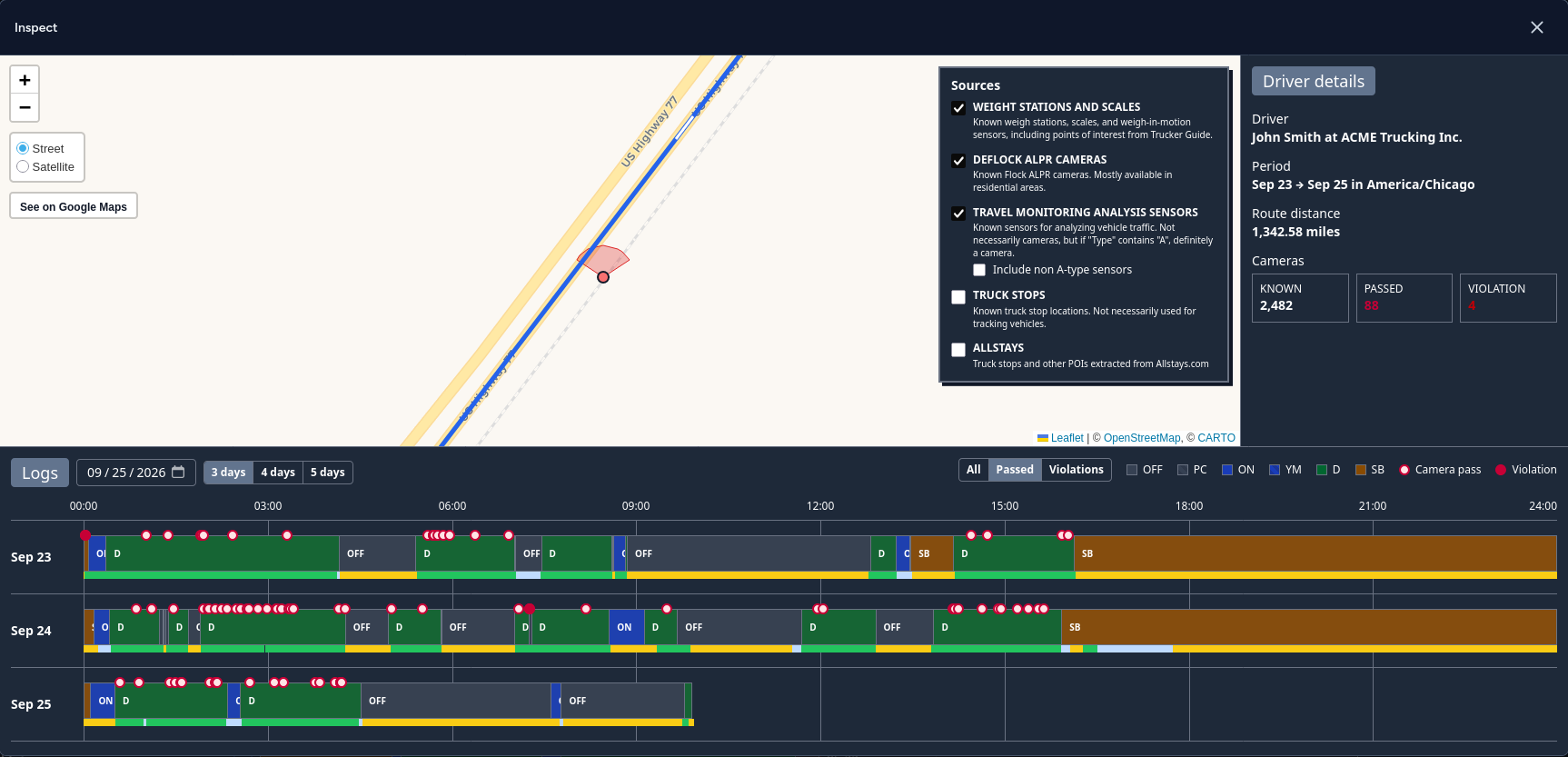
- Correlates actual vehicle sightings with recorded duty-status events.
- Surfaces time-and-location mismatches for focused review.
- Helps distinguish clerical mistakes and assignment issues from concerning patterns.
- Creates a documented path from detection through investigation and resolution.
- Supports proactive coaching before a discrepancy becomes a roadside or audit problem.
Use the signal before an inspector does
The practical lesson for carriers is simple: a log should make sense when compared with the rest of the operation. ELD data, dispatch activity, fuel and toll records, GPS history, and properly obtained ALPR sightings can each tell part of the story. The strongest compliance program reconciles those signals while the trip is still fresh.
As roadside and investigative data becomes easier to connect, relying on the log screen alone becomes less defensible. A privacy-conscious review process gives the carrier a chance to correct legitimate errors, address risky behavior, and build an accurate record before an external review finds the discrepancy first.